- Free Consultation: (213) 251-5533 Tap Here to Call Us




My U.S. Visa Was Revoked. Do I Have to Leave? A Guide for Students, Workers, and Visitors in Los Angeles


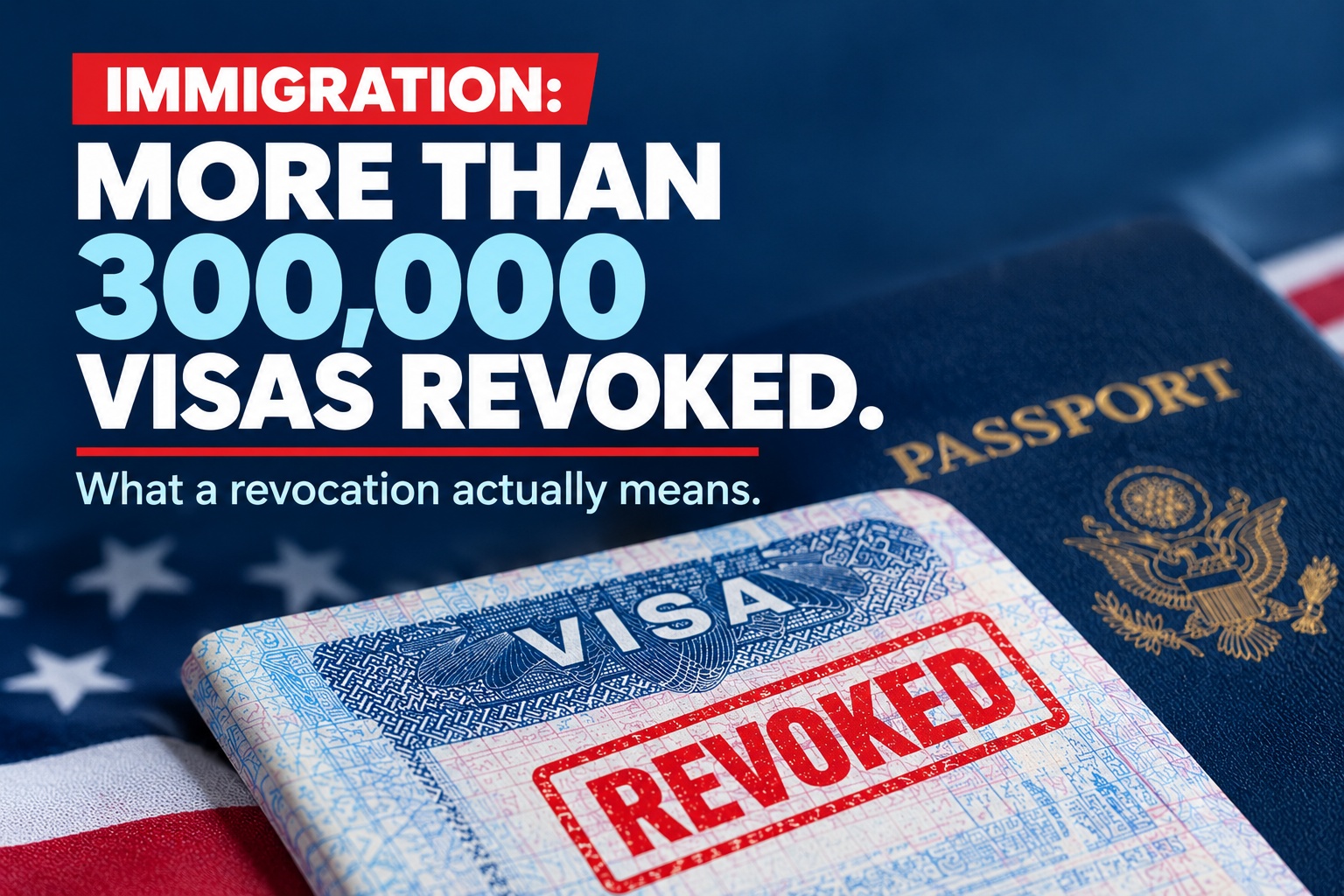
A revoked visa does not automatically mean you must leave the United States tomorrow. It is serious, and it can lead to removal, but a visa and your permission to stay are two different things. If you are an F-1 student, an H-1B or other temporary worker, or a visitor in Los Angeles who just opened a revocation email, this guide explains what changed, what did not, and what to do in the first week.
This article is general information, not legal advice.
The numbers: more than 300,000 revocations since January 2025
The State Department now says it has revoked more than 300,000 visas since January 2025. The total has risen fast this year:
| Announced | Reported total revoked since Jan. 2025 | Source |
|---|---|---|
| Oct. 20, 2026 | More than 300,000 | State Department official and spokesman, via Al Jazeera |
| Aug. 10, 2026 | More than 175,000 | State Department release |
| Jan. 2026 | More than 100,000 | State Department statement, reported by Al Jazeera |
Stated reasons. In August, the Department said it revoked visas of people who violated visa terms, committed crimes, called for violence against Americans, committed fraud, abused the immigration system, or endangered national security. It credited “continuous vetting” of people who already hold visas. In October, an official said the majority were for criminal activity or public safety: about 25% for assault, 22% for DUI, 7% for theft and 7% for drug offenses, plus more than 4,000 tied to birth tourism.
What the numbers don’t tell you. The Department has not published a breakdown by visa type, or by how many holders were inside the U.S. when their visa was revoked. A revocation is also not a deportation order. Some notices give no specific reason at all.
The State Department’s own visa FAQs make the point: a visa’s expiration date has no connection to how long DHS lets you stay. People routinely stay lawfully on an expired visa because their I-94 is still valid. The same logic is why a revoked visa does not automatically make your stay unlawful. Once you are in the United States, DHS, not the State Department, decides whether you may remain.
What a revocation changes, and what it doesn’t
A revocation ends your ability to travel on that visa, and it gives DHS a ground to start removal proceedings. It does not deport you on its own.
Who can revoke, and why. Under 8 U.S.C. 1201(i) (INA 221(i)) and 22 C.F.R. 41.122, a consular officer or the Secretary of State may revoke a nonimmigrant visa at any time, in their discretion. The regulation also allows a provisional revocation while the Department reviews new information about your eligibility. Many notices describe this as a prudential revocation: a precaution taken after an arrest or other new information, not a final finding that you did anything wrong.
Travel and re-entry. Once the revocation is entered in the State Department’s lookout system (CLASS), the visa is no longer valid for travel, even if you never received the notice. If you leave the U.S., you cannot come back on that visa. You would need to apply for a new one abroad, and there is no guarantee you will get it.
Possible removal proceedings. 8 U.S.C. 1227(a)(1)(B) (INA 237(a)(1)(B)) makes a person deportable if their nonimmigrant visa was revoked under INA 221(i). That means DHS can issue a Notice to Appear and place you in removal proceedings before an immigration judge. It does not happen automatically, and you have the right to a hearing and to a lawyer at your own expense.
Limited review. Federal courts generally cannot review a visa revocation. The one statutory exception is in removal proceedings when the revocation is the only ground charged. That is a key reason to keep your status clean: if the revocation stands alone, you have more room to contest it.
What it doesn’t change. Your I-94, your SEVIS record, your H-1B approval and any pending applications are separate records. Each can be affected, but none ends automatically just because the visa stamp was revoked. Check the effective date on your notice too: some revocations take effect immediately, others only when you depart.
Special issues for F-1 students and H-1B workers
For students and workers, the visa revocation is often less urgent than what happens to the status records behind it.
F-1 students: SEVIS and your DSO
Your SEVIS record is your status. F-1 students are usually admitted for “D/S,” meaning you stay in status as long as your SEVIS record is active and you follow the rules. A visa revocation does not automatically terminate SEVIS, but it can prompt a review.
Talk to your school’s DSO (Designated School Official) early. Ask whether your SEVIS record is still active, and get the answer in writing. LA-area international student offices have handled many of these cases since 2025.
Keep doing everything right. Stay enrolled full-time, work only as authorized (on-campus, CPT or OPT), and report address changes.
If SEVIS is terminated, the clock matters. Options may include reinstatement through USCIS or a transfer, depending on why it happened. In spring 2025, thousands of students were removed from SEVIS and later restored, so a termination should be checked with a lawyer, not assumed final.
Don’t travel home for winter break without legal advice. You will need a new F-1 visa to return.
H-1B workers: your employer and your petitions
Your H-1B approval is separate from the stamp. USCIS approved your employer’s petition; the State Department revoked the visa. The approval and your I-94 normally remain in effect unless DHS acts on them.
Tell your employer’s immigration counsel, not just HR. Your employer must keep paying the required wage while you work in H-1B status. If it ends your job, it must notify USCIS and offer to pay your return transportation.
Know the 60-day grace period. If employment ends, you generally have up to 60 days (or until your I-94 expires, if sooner) to find a new sponsor, change status or leave.
Pending filings need a strategy. Extensions, transfers to a new employer, PERM, I-140 and green card applications will usually ask about arrests and prior visa actions. Answers must be accurate and consistent.
H-4 family members depend on your status, so their plans should be reviewed at the same time.
Visitors (B-1/B-2) and other workers follow the same rule: your I-94 date, not the visa, governs your stay. An extension request may be harder to win after a revocation, so get advice before filing one.
Your first-week checklist
The first seven days are about protecting your options. Most of the damage in these cases comes from a rushed trip or a careless reply, not from the notice itself.
Step 1: Save the notice. Keep the original email or letter, the sender’s address, and the date and time you received it. Screenshot it, and forward a copy to a personal email account you control.
Step 2: Don’t travel. Do not leave the U.S., even to Canada or Mexico, until a lawyer has reviewed your case. You cannot return on a revoked visa.
Step 3: Check your I-94. Download your most recent record and travel history from CBP’s I-94 website. Note your admission class and your “admit until” date or “D/S.”
Step 4: Stay in status. Keep going to class or work, follow your employment rules, and don’t let any deadline lapse. Students should confirm with the DSO that SEVIS is active.
Step 5: Gather your records. Collect your passport, visa, I-20 or I-797 approval notices, pay stubs or transcripts, and any police reports, court records or dispositions if there was ever an arrest, even one that was dismissed.
Step 6: See an immigration attorney before you respond. Don’t email the consulate, post about your case online, or answer questions from officials about the underlying facts until you’ve had advice. What you say now can follow you into future applications.
Applying for a new visa later, and other options
A revocation is not a lifetime ban. Whether you can get a new visa depends on why it was revoked and how you handle the next application.
Reapplying. You will file a new DS-160 and attend an interview abroad. You must disclose the revocation and any arrest behind it. The officer will decide whether the underlying facts make you ineligible. A DUI arrest that was dismissed is very different from a fraud finding, which can carry a permanent bar.
Reversal of a provisional revocation. Under 22 C.F.R. 41.122(b), a provisional revocation can be reversed if the Department confirms you remain eligible. If that happens, the visa becomes valid again on its original terms. Court records showing a case was dismissed or reduced can matter here.
Waivers. If you are found inadmissible, a nonimmigrant waiver under INA 212(d)(3)(A) may still let you visit, study or work temporarily. Waivers are discretionary and take time, so they should be planned well before any travel date.
A different status. Depending on your facts, a change of status, an employer petition, or a family- or humanitarian-based application may let you stay without a new visa stamp. These options can close if you fall out of status. Remaining in the U.S. unlawfully for more than 180 days triggers a 3-year bar to returning, and more than one year triggers a 10-year bar. Timing matters.
Talk to an immigration attorney in Los Angeles before you act
If you or a family member received a visa revocation notice, contact Thomas M. Lee Law Offices APLC at (213) 251-5533 before you travel or respond. We help F-1 students, H-1B and other workers, and visitors across the Los Angeles area understand what a revocation means for their status and plan their next step.
Legal Disclaimer and Contact Information
The information provided in this article is for educational and informational purposes only and does not constitute formal legal advice. Reading this material does not create an attorney-client relationship. Every case involves unique facts, and individuals seeking guidance on their case should consult an experienced attorney for legal advice. For a free phone consultation with Attorney Thomas Lee, please call (213) 251-5533.
Sources
Al Jazeera: Trump official claims record-breaking 300,000 visas were revoked (Oct. 20, 2026)
U.S. Department of State: State Department Revokes More Than 175,000 Visas (Aug. 2026)
22 C.F.R. 41.122, Revocation of visas
8 U.S.C. 1201(i), Revocation of visas (INA 221(i))
8 U.S.C. 1227(a)(1)(B), Deportable aliens (INA 237(a)(1)(B))