- Free Consultation: (213) 251-5533 Tap Here to Call Us




EB-1A and NIW Petitions in 2026: Why USCIS Is Getting Tougher—and How to Win Anyway


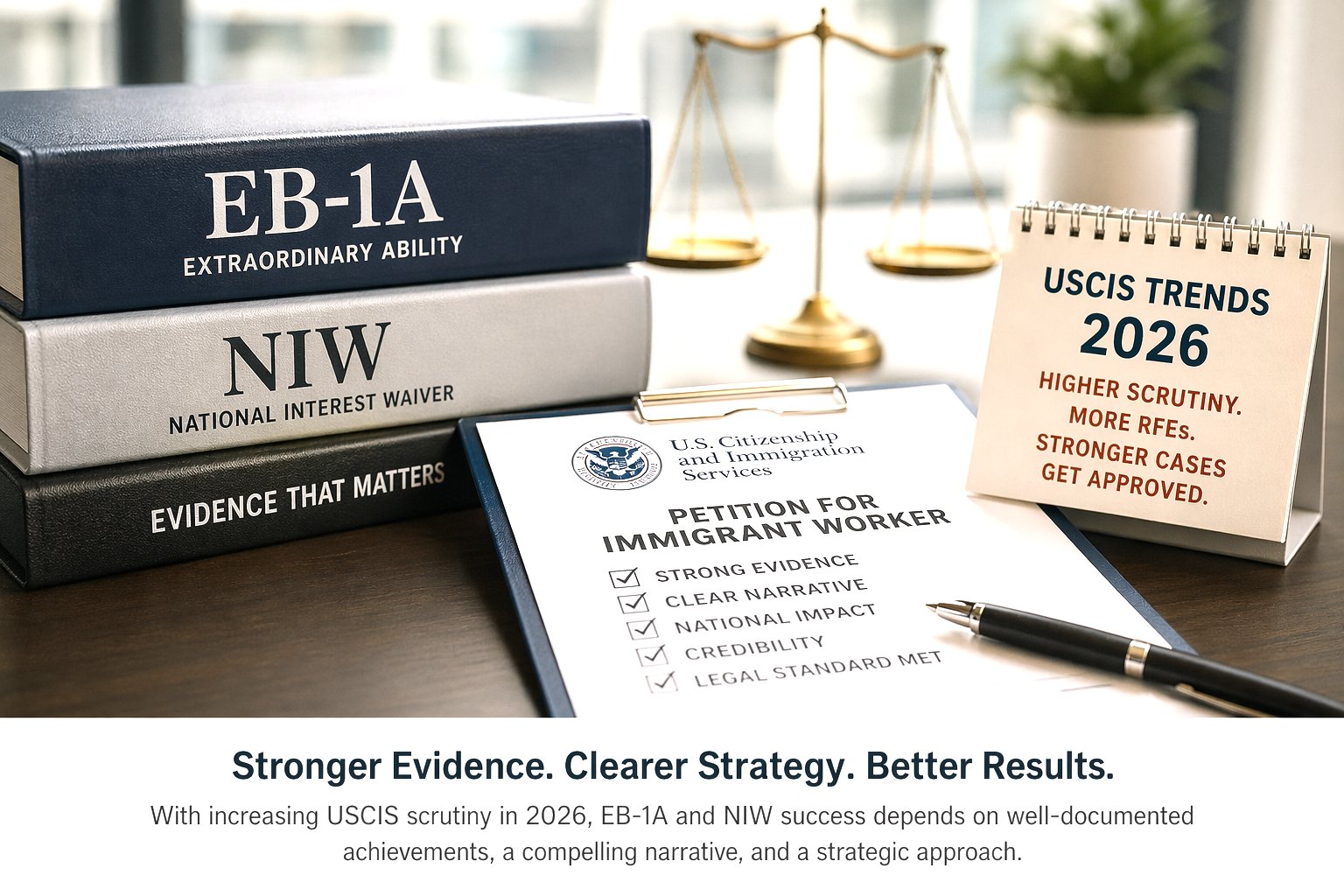
Those who are considering filing an EB-1A extraordinary ability petition or a National Interest Waiver (NIW) need to understand a critical reality: the legal standards have not changed dramatically, but how USCIS applies those standards has shifted in a meaningful and often unfavorable way.
Over the past year, practitioners and former adjudicators have consistently observed a measurable decline in approval rates, a sharp increase in Requests for Evidence (RFEs), and a rise in inconsistent or unpredictable decisions. These developments are not random. They reflect a broader institutional change within USCIS that directly impacts how your case will be reviewed.
The most important development is a shift in agency mindset. USCIS leadership has increasingly emphasized a role as a screening and enforcement body rather than a benefits-granting agency. That shift affects discretionary decisions, especially in subjective categories like EB-1A and NIW, where adjudicators have significant latitude. When discretion tightens, borderline cases that might have been approved in prior years are now more likely to be denied.
It would be a mistake to assume that these outcomes are driven primarily by new statutes or regulations. In many cases, the underlying law remains the same. What has changed is how adjudicators interpret and apply that law in practice. The current adjudication climate reflects a heightened concern about fraud, an institutional effort to narrow eligibility, and an increased willingness to challenge claims that are not supported by strong, objective evidence.
Another contributing factor is operational. USCIS has experienced a reduction in experienced personnel, including senior adjudicators who took retirement or left government service. As a result, newer officers are making complex determinations in highly technical fields without the same depth of institutional knowledge. This has led to more erratic RFEs, overlooked evidence, and decisions that can appear inconsistent or poorly reasoned.
Applicants often assume that adjudicators will understand the nuances of their profession. That assumption is incorrect. USCIS officers are not experts in artificial intelligence, medicine, engineering, finance, or other specialized fields. They are trained to evaluate whether the evidence presented is credible, verifiable, and sufficient under the applicable legal standard. If your case depends on technical sophistication that is not clearly explained, it increases the likelihood of an RFE or denial.
Equally important is the reality of time constraints. Even complex employment-based petitions may receive only a limited number of hours for review. That means adjudicators are not reading your petition as a comprehensive narrative from start to finish. They are looking for clear, direct evidence that maps efficiently onto the legal criteria. If your strongest evidence is buried or your argument requires inference, you are increasing the risk that it will be missed.
This is one reason why premium processing often results in more RFEs. When adjudicators are working under strict deadlines, any ambiguity tends to trigger a request for additional evidence rather than a favorable decision. The issue is not necessarily the strength of the case, but the clarity and accessibility of the presentation.
There is also a growing enforcement focus on the authenticity of supporting evidence. USCIS and the Department of State are increasingly identifying patterns involving publications, expert letters, and other commonly used forms of proof. For example, applicants publishing in unrelated foreign journals or submitting articles that closely resemble other filings may raise credibility concerns. The use of artificial intelligence to generate or replicate content has made it easier for the government to detect these patterns. As a result, attempts to artificially enhance a profile can undermine an otherwise viable case.
In this environment, the difference between approval and denial often comes down to how effectively the case is structured. Successful EB-1A and NIW petitions are not simply collections of achievements. They are carefully constructed legal arguments supported by independent, objective evidence that is easy for an adjudicator to understand and verify. The narrative must be coherent, the documentation must be credible, and the connection between the two must be explicit.
It is also important to recognize that not every case should be filed immediately. One of the most common strategic errors is pursuing an EB-1A or NIW petition before the applicant’s profile is sufficiently developed. Given current adjudication trends, a premature filing can result in a denial that complicates future immigration options. In some situations, it is more effective to delay filing, strengthen the evidentiary record, and pursue a more conservative immigration strategy in the interim.
Despite these challenges, it would be incorrect to conclude that EB-1A and NIW pathways are no longer viable. USCIS continues to approve qualified applicants on a daily basis. What has changed is the margin for error. Strong cases that are well-presented still succeed. Weak or poorly structured cases are increasingly filtered out.
For prospective applicants, the key takeaway is that success in today’s environment requires a different approach. It is no longer enough to meet the minimum criteria. Your case must be built with an understanding of how USCIS officers actually review and evaluate evidence under current conditions. That requires strategic planning, disciplined presentation, and a realistic assessment of strengths and weaknesses.
At Thomas M. Lee Law Offices, we focus on providing candid evaluations and evidence-driven strategies for EB-1A and NIW petitions. If you are considering filing, the first step is determining whether your case is positioned for success under current USCIS trends, not outdated assumptions about how the system used to operate.
The information provided in this article and website is intended for general information purposes only and is not to be relied upon as legal advice. For a free phone consultation with Attorney Thomas Lee, please call (213) 251-5533.