- Free Consultation: (213) 251-5533 Tap Here to Call Us




Trump Administration Appeals Order Blocking Fixed-Period-of-Stay Rule for F, J and I Visa Holders


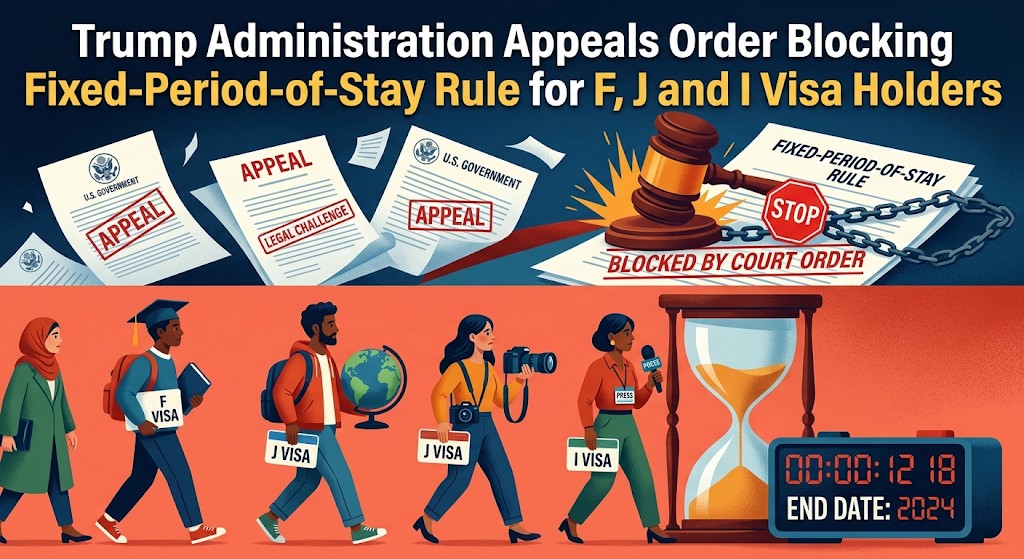
The Trump administration has appealed the federal court order that blocked the Department of Homeland Security’s fixed-period-of-stay rule. The government filed its notice of appeal to the First Circuit on September 30, 2026.
The appeal does not put the rule into effect. Duration of Status, known as D/S, still governs F-1 students, J-1 exchange visitors and I foreign media representatives while the case proceeds.
What the rule would change
The rule would swap open-ended admission for a fixed end date on every F, J and I admission. DHS published it on July 17, 2026, at 91 Fed. Reg. 44976, with an effective date of September 15, 2026.
D/S has governed F admissions since 1978 and J admissions since 1985. Under it, a student or exchange visitor may stay for the length of the authorized program, as long as status is maintained.
For F-1 students and J-1 exchange visitors, the rule would cap admission at four years or the program end date, whichever comes first. Today they are admitted for the length of the authorized program. Foreign media representatives in I status, now generally admitted for the length of their assignment, would be limited to 240 days or the end of the assignment.
Anyone needing more time would have to file an Extension of Stay request on Form I-539, which DHS would decide at its discretion. Under the current system, the school or program sponsor extends the program record instead.
The rule would also cut the F-1 departure period from 60 days to 30 days. And it would restrict academic changes, limiting graduate transfers, changes of educational objective and second degrees at the same or a lower level.
The practical shift is from status kept through compliance to status kept through repeated government approvals. Doctoral students would feel it most, because their programs commonly run longer than four years. Rule details are drawn from the AILA analysis of the order.
What the court ordered
Judge F. Dennis Saylor IV of the District of Massachusetts postponed the rule’s effective date on September 14, 2026, one day before it was due to start. The case is Presidents’ Alliance on Higher Education and Immigration v. DHS, No. 1:26-cv-13799.
The order applies nationwide and covers the whole rule. It also bars DHS and ICE from taking further steps to implement the rule while the case continues.
The court found the plaintiffs likely to succeed on their Administrative Procedure Act claim that the rulemaking was arbitrary and capricious. It identified four weaknesses in how DHS made the rule.
First, DHS did not give a reasoned account of the rule’s costs, including projected enrollment losses. Second, it did not seriously consider less restrictive alternatives raised in public comments. Third, it did not respond meaningfully to significant comments, including evidence on how long doctoral programs take. Fourth, it did not explain how a four-year cap serves its stated security and fraud goals.
The judge postponed the rule and did not strike it down. He left the plaintiffs’ First Amendment and statutory claims undecided, and denied vacatur for now without closing the door on it.
The plaintiffs are a coalition led by NAFSA and the Presidents’ Alliance, joined by AICUM, the American Federation of Teachers, UAW and The NewsGuild-CWA. The memorandum and order is posted on the Presidents’ Alliance litigation page.
What the appeal does and does not do
Filing a notice of appeal sends the dispute to the First Circuit. It does not suspend the district court’s order, and it does not give the rule an effective date.
The rule could take effect during the appeal only if a court stays the order. The government would have to request that relief from the district court or the First Circuit.
Open question: no stay motion had been publicly reported as of October 2, 2026. Confirm against the docket before publishing.
The case now runs on two tracks.
In the First Circuit, the appeals court will review the preliminary order. That review usually takes months, and no briefing schedule has been reported yet.
In the district court, the merits case continues before Judge Saylor, where the plaintiffs can renew their request to vacate the rule. A status conference was set for October 2, 2026.
One issue to watch is the nationwide reach of the order. The government argued below that Trump v. CASA limits relief to the parties, and the judge disagreed.
Three outcomes are realistic. The First Circuit could affirm, leaving D/S in place through the merits. It could reverse or grant a stay, which would let DHS set a new effective date. Or DHS could start a new rulemaking to repair the defects the court identified.
What to do now
Nothing changes today for people admitted for D/S. No four-year clock has started, and no extension filing is required because of this rule.
Students and exchange visitors should keep maintaining status as before. The 60-day F-1 departure period still applies, and an I-94 marked D/S remains valid.
Schools and program sponsors should continue current SEVIS procedures. They should also keep transition plans on file, because the rule is postponed and has not been withdrawn.
For employers, OPT, STEM OPT and J-1 hiring follow the existing framework, and no new extension-of-stay tracking is needed for now. Foreign media organizations can likewise rely on I admissions continuing without the 240-day cap.
The court order does not fix status problems that arise for other reasons. Anyone with an expiring program date, a lapse in enrollment or a pending travel plan should speak with a school official or immigration counsel.
The situation can change quickly. A stay or an appellate ruling could revive the rule, so affected people should follow updates from their school, sponsor or counsel.
Legal Disclaimer and Contact Information
The information provided in this article is for educational and informational purposes only and does not constitute formal legal advice. Reading this material does not create an attorney-client relationship. Every case involves unique facts, and individuals seeking guidance on their case should consult an experienced attorney for legal advice. For a free phone consultation with Attorney Thomas Lee, please call (213) 251-5533.