- Free Consultation: (213) 251-5533 Tap Here to Call Us




California Moves To Ban AI Emotion And Neural Tracking At Work


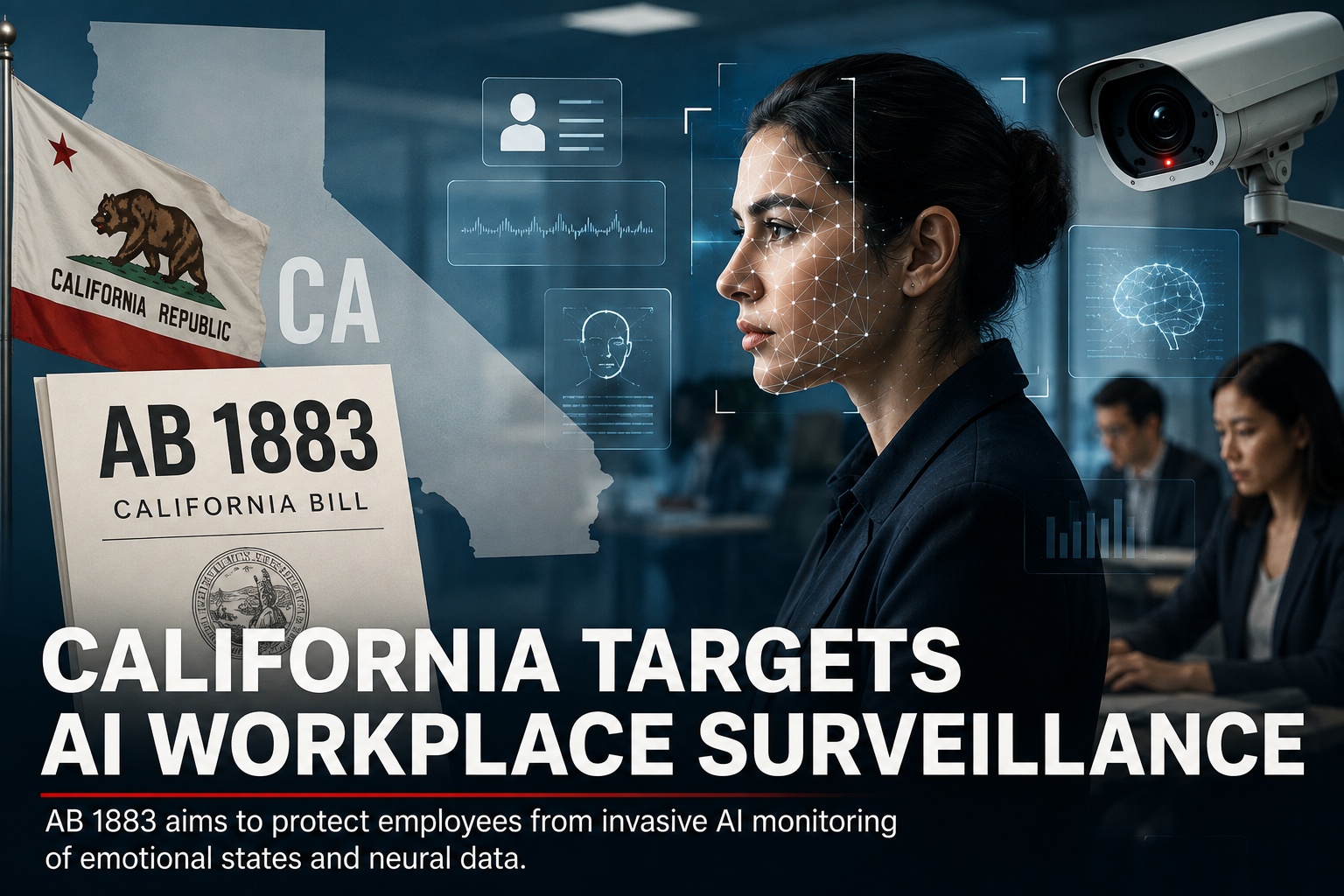
Workplace surveillance has come a long way from the office break-room camera. Employers today can track keystrokes, monitor location, and analyze tone of voice — and now some are experimenting with AI tools that claim to detect how employees are feeling, or even tap into signals from their nervous system. California lawmakers just decided that’s a line worth drawing.
On August 30, the state legislature gave final approval to AB-1883, a bill that would prohibit employers from using AI-powered workplace surveillance tools to recognize, infer, or predict an employee’s emotional state, or to collect what the bill calls “neural data.” The bill now sits on Governor Gavin Newsom’s desk, and he has until the end of September to sign it or veto it.
The legislation casts a wide net when it comes to definitions. A “workplace surveillance tool” covers any system, app, instrument, or device that collects employee data, activities, communications, actions, biometrics, or behaviors through means other than direct in-person observation — think video and audio monitoring, continuous time-tracking, geolocation, and electromagnetic or photoelectronic tracking. That’s the everyday stuff many employers already use.
Where AB-1883 gets more forward-looking is its treatment of neural data, which it defines as information generated by measuring the activity of an employee’s central or peripheral nervous system — pushing the bill’s reach well past cameras and badge scanners into emerging neurotechnology. And the bill isn’t limited to private companies: its definition of “employer” is broad enough to sweep in state and local government entities, charter cities, and public higher education institutions as well.
Importantly, this isn’t a blanket ban on workplace monitoring. The bill explicitly allows employers to keep using surveillance tools for safety or other legitimate purposes, as long as those tools don’t cross into AI-driven emotion recognition or neural data collection. It’s a narrowly targeted restriction, not a crackdown on monitoring in general.
There’s also a financial stick behind the rule. Violations could cost employers up to $500 each — and while that sounds modest, the number could climb fast for large employers if regulators or courts count violations per employee, per use, or per incident.
If Newsom signs AB-1883 — or simply lets the deadline pass without a veto — the law would take effect on January 1, 2027, giving employers a runway to review their surveillance tools and get ahead of compliance. Given California’s track record of setting the pace on privacy and biometric law, businesses well outside the state may want to start paying attention too.