- Free Consultation: (213) 251-5533 Tap Here to Call Us




BREAKING: The U.S. Just Announced a new 75-Country Immigrant Visa Suspension on January 14, 2026! What Does It Means for Immigrants?


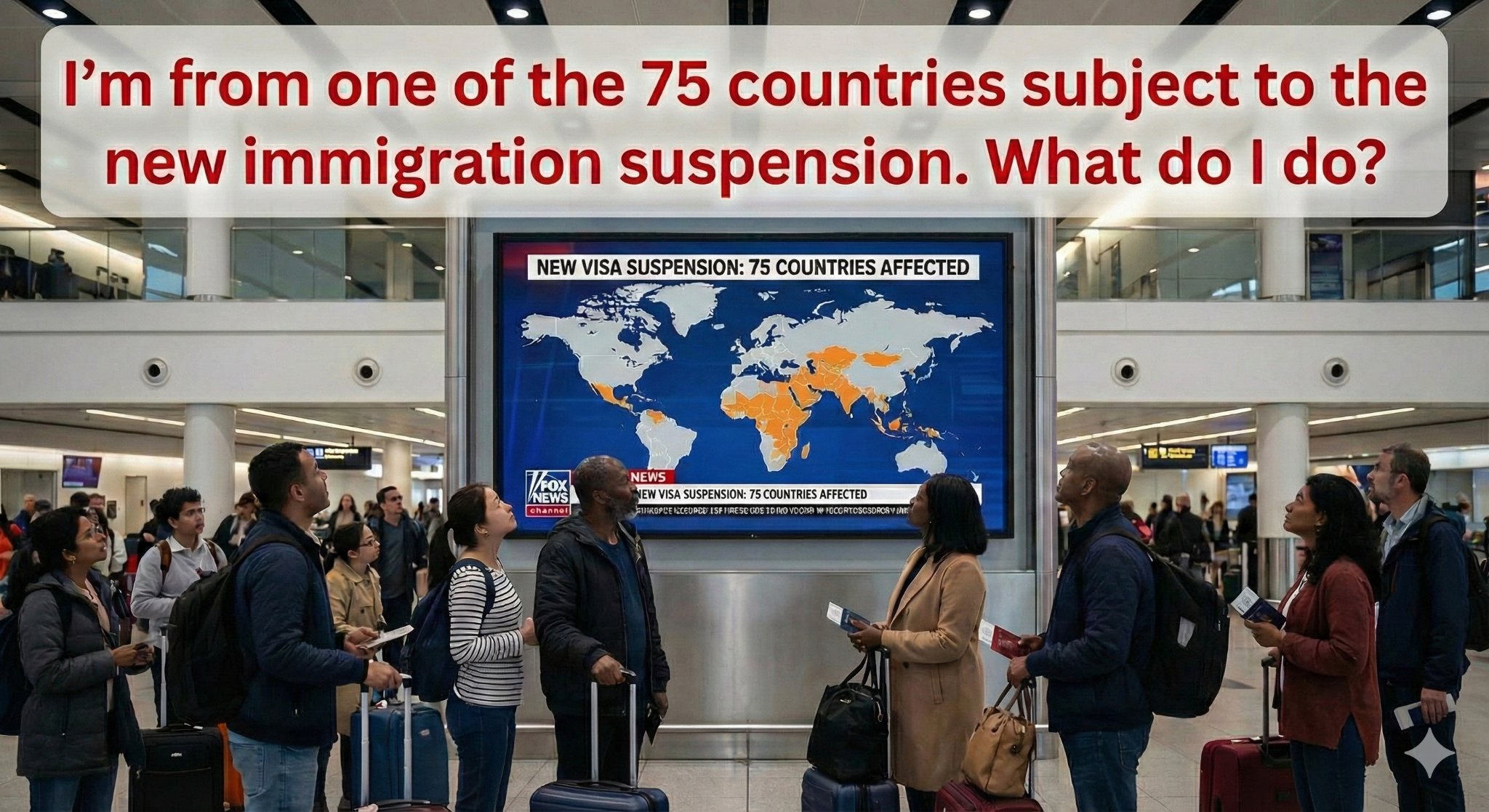
What We Know So Far About the Reported 75-Country Immigrant Visa Suspension and What It Means for You
On the morning of January 14, 2026, many immigrants and U.S. petitioners have seen alarming headlines claiming that the United States has imposed a “75-country immigrant visa ban” effective January 21, 2026. Understandably, this language has caused panic among families waiting for immigrant visas, including spouses, parents, and children of U.S. citizens and lawful permanent residents. Before making any decisions based on fear or speculation, it is critical to separate what is actually happening from what is being overstated or misunderstood.
As of today (1/14/2026), there is no publicly released law, regulation, presidential proclamation, or Federal Register notice that formally lists 75 countries subject to a blanket immigrant visa ban. Instead, what exists is reporting by major news outlets describing an internal U.S. Department of State memorandum or cable directing consular posts to pause or slow immigrant visa processing for nationals of certain countries while additional screening procedures are reviewed. That distinction matters legally and practically.
Media reports citing Reuters, AP News, ABC News, and The Guardian indicate that the guidance originated from an internal State Department directive obtained by journalists, not from a public legal instrument that can be challenged directly in court. You can review examples of this reporting here:
https://www.reuters.com/world/us/us-suspend-visa-processing-75-nations-next-week-fox-news-reports-2026-01-14/
https://apnews.com/article/79909bd01e9e1e3dedde144f865a1b9d
https://abcnews.go.com/US/us-suspend-visa-processing-75-countries-starting-week/story?id=129210370
Because the memo itself has not been released, its exact scope, legal citations, duration, and exceptions remain unclear. That uncertainty is not accidental. Historically, the Department of State often uses internal consular guidance to implement restrictive immigration policies quietly, particularly when relying on existing presidential authority under the Immigration and Nationality Act.
The legal authority most often cited in connection with these actions is INA § 212(f), codified at 8 U.S.C. § 1182(f), which grants the President broad power to suspend the entry of foreign nationals when their entry is deemed detrimental to U.S. interests. The statute itself is extremely broad and has been upheld by the U.S. Supreme Court, most notably in Trump v. Hawaii, 138 S. Ct. 2392 (2018). You can read the statute here:
https://www.law.cornell.edu/uscode/text/8/1182
What is important for immigrants to understand is that a pause in visa processing is not the same thing as a permanent ban, and it is not the same thing as an automatic denial. In most cases, consular officers are being instructed to hold or delay cases rather than formally refuse them under INA § 221(g), which is the standard refusal used when additional review is required. This means that many cases remain legally alive, even if they are not moving forward at the pace applicants expected.
Another common misconception is that this policy applies to everyone from the affected countries regardless of immigration category. That is unlikely. Even under the most restrictive travel bans in U.S. history, exceptions existed for certain family-based immigrants, dual nationals, humanitarian cases, and applicants whose entry was deemed in the national interest. Without the text of the memo, it would be legally reckless to assume there are no exceptions here.
It is also critical to understand what this policy does not do. It does not cancel approved immigrant petitions filed with USCIS. It does not revoke green cards already issued. It does not automatically affect adjustment of status cases filed inside the United States. It does not prevent U.S. citizens from filing new family petitions. The bottleneck, at least based on current reporting, appears to be at U.S. embassies and consulates abroad.
If you are waiting for a marriage-based immigrant visa, a parent or child immigrant visa, or another family-based category, the most realistic outcome is delay rather than denial. Delays are emotionally devastating, but legally they are often survivable with proper strategy. In some cases, alternatives such as adjustment of status, humanitarian parole, or litigation may become relevant, depending on the facts.
It is also worth addressing the elephant in the room. Immigration policy in the United States is highly political, and internal agency guidance can change rapidly with elections, lawsuits, or diplomatic pressure. Many prior “bans” were modified, narrowed, or rescinded without ever being fully implemented across all posts. Assuming that this policy will remain fixed or permanent is an assumption not supported by historical evidence.
For immigrants reading sensational headlines, the most dangerous decision you can make right now is to abandon your case, stop responding to consular requests, or assume you are permanently barred from immigrating. Immigration law punishes inaction just as harshly as mistakes. Until there is a formal refusal, your case still exists.
If you are affected by delays at a U.S. embassy or consulate, document everything, preserve correspondence, and consult with an immigration attorney who understands consular processing, administrative processing, and federal litigation options. Consular nonreviewability is not absolute, and in some circumstances, unreasonable delay can be challenged in federal court.
For official government context on visa processing and announcements, you can monitor the Department of State’s visa news page here:
https://travel.state.gov/content/travel/en/News/visas-news.html
You can also review prior State Department suspension notices to understand how similar policies have been implemented in the past:
https://travel.state.gov/content/travel/en/News/visas-news/suspension-of-visa-issuance-to-foreign-nationals-to-protect-the-united-states-from-foreign-terrorists-and-other-national-security-and-public-safety-threats.html
The bottom line is this. The reported 75-country immigrant visa suspension is real in the sense that consular processing has slowed or paused for many applicants, but it is not yet a published law, it is not transparent, and it is not necessarily permanent. Fear is understandable, but panic is not a strategy. Accurate legal analysis and individualized planning are.
If you or your family are affected, now is the time to get informed, not discouraged. Call Attorney Thomas Lee at (213) 251-5533 for a free legal consultation about your case and how it may be impacted by this new suspension.
This article is provided for general informational purposes only and does not constitute legal advice. Reading this article or contacting the author does not create an attorney-client relationship. Immigration law is highly fact-specific and subject to rapid change.