- Free Consultation: (213) 251-5533 Tap Here to Call Us




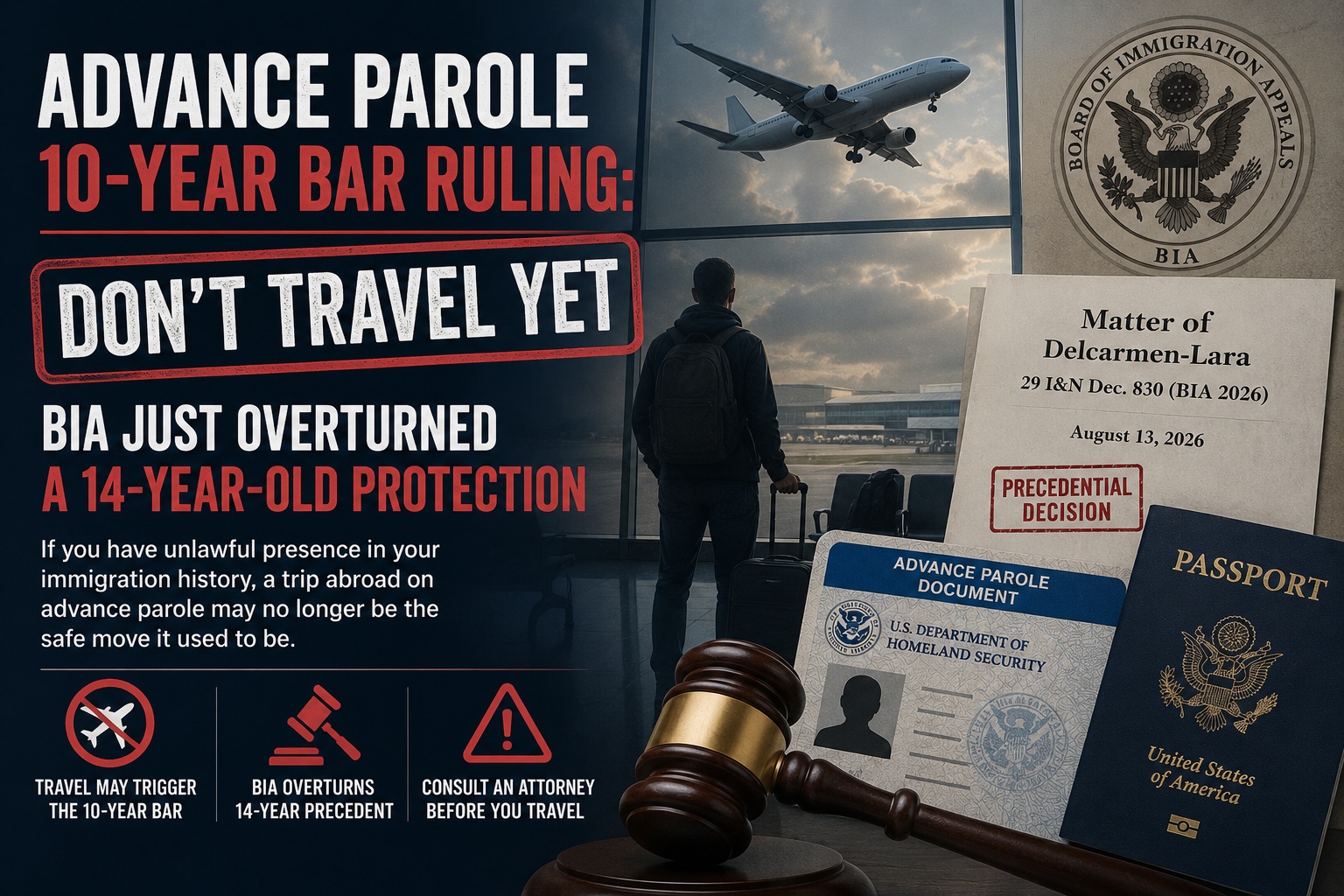
Don’t Travel on Advance Parole Yet: BIA Just Overturned a 14-Year-Old Protection


By Thomas M. Lee
If you have unlawful presence in your immigration history, a trip abroad on advance parole may no longer be the safe move it used to be.
On August 13, 2026, the Board of Immigration Appeals (BIA) issued a precedential decision — Matter of Delcarmen-Lara, 29 I&N Dec. 830 (BIA 2026) — that upends more than a decade of settled immigration practice. The Board ruled that leaving the United States on advance parole does count as a “departure” for purposes of the unlawful presence bars under INA § 212(a)(9)(B). In doing so, it explicitly overruled Matter of Arrabally and Yerrabelly, 25 I&N Dec. 771 (BIA 2012) — the case that, since 2012, had told adjustment applicants, DACA recipients, and others that traveling on advance parole would not trigger the 3- or 10-year bars.
This is a big deal, and if you’re planning international travel on advance parole, it’s worth pausing until you understand how it might apply to you.
What Changed
For 14 years, Arrabally and Yerrabelly was one of the most relied-upon precedents in immigration practice. The reasoning was simple: someone leaving on advance parole isn’t really “departing” in the legal sense, because the government has already promised to let them back in. Because of that, a person with a year or more of unlawful presence could travel on advance parole without worrying that their return trip would trigger the 10-year bar.
Delcarmen-Lara throws that reasoning out. The BIA panel — Deputy Chief Appellate Immigration Judge Gorman, joined by Appellate Immigration Judges Montante and Gallow — held that a departure under a grant of advance parole is a departure within the meaning of INA § 212(a)(9)(B)(i)(II), the ten-year bar provision. The Board went further, clarifying that a person can become inadmissible under that section specifically because of a trip taken on advance parole.
The Practical Effect
Under INA § 212(a)(9)(B), accruing more than 180 days of unlawful presence and then departing the U.S. can trigger a three-year bar to readmission, while accruing a year or more and then departing can trigger the far more serious ten-year bar. Before this ruling, a departure on advance parole was treated as not “counting” toward either of these triggers, which meant that even someone with significant unlawful presence generally wouldn’t set off the bar just by using advance parole to travel. Now that protection is gone: a departure on advance parole counts like any other departure, so if you had already accrued enough unlawful presence before you left, that trip abroad can trigger the bar the moment you try to come back.
Advance parole itself hasn’t disappeared, and it isn’t inherently unsafe for everyone. People with no unlawful presence, or who fall under an exception or exemption — for example, certain time accrued as a minor, pending asylum applicants, or other statutory exceptions — aren’t automatically affected in the same way. But the blanket protection that unlawful-presence accruers used to rely on no longer exists.
Who Should Be Paying Attention
The people most exposed by this decision are adjustment of status applicants with a history of unlawful presence, DACA recipients weighing advance parole travel, TPS holders and humanitarian parole recipients who also have unlawful presence in their background, and really anyone who was previously told by an attorney that advance parole travel was safe based on the old rule. If that describes you, this ruling should change how you think about any trip you’re currently planning.
Bottom Line
Don’t assume an approved advance parole document protects you from the 3- or 10-year bar anymore. This decision is only hours old as of this writing, and the immigration bar is still digesting its full implications — including whether it will be challenged, how USCIS and the State Department will implement it, and whether any transition relief applies to people who already have advance parole in hand.
If you have any unlawful presence in your history and you’re weighing a trip abroad, talk to an immigration attorney before you travel — not after you’ve already left. The stakes here are a decade of inadmissibility, and that’s not a risk to take on a guess.
Legal Disclaimer and Contact Information
The information provided in this article is for educational and informational purposes only and does not constitute formal legal advice. Reading this material does not create an attorney-client relationship. Every case involves unique facts, and individuals seeking guidance on their case should consult an experienced attorney for legal advice. For a free phone consultation with Attorney Thomas Lee, please call (213) 251-5533.